
Green Party
Sony Pictures Imageworks directs a crew of 80 animators, including a few feature film novices, who create CG characters and hybrids for Green Lantern
By Barbara Robertson
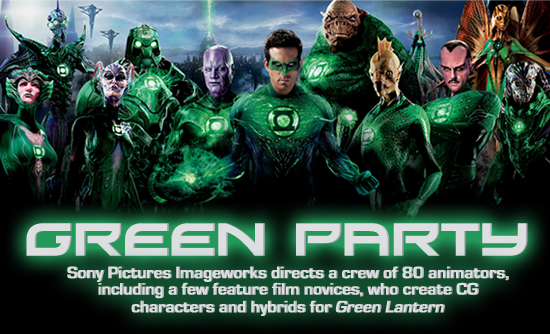
Green Lantern, one of six movies based on comic books destined to fight for audience share in movie theaters this summer, lands in the unenviable calendar slot between X-Men: First Class (June 3) and Disney/Pixar’s Cars 2 (June 24). Can Hal Jordon, the first human recruited into the elite Green Lantern Corps, power people into a ticket line? That might depend on actor Ryan Reynolds who plays Jordon — or, at least his head does when he’s wearing his superpower-granting green ring. His body becomes a special energized suit, and that suit is digital; the suit is, in effect, a character. To move it, a team of animators at Sony Pictures Imageworks matched and extended Reynolds’ performance; a team of visual effects artists fastened the CG suit to footage of Reynold’s head.
“The suit is digital because of the internal illumination and external energy that licks off the surface,” says David Schaub, animation supervisor. “The suit also has a semi-translucent quality that is similar to the material properties found in the rocks and buildings on the planet Oa. That unique and other-worldly quality was best achieved by making the suit all CG. The suit itself was designed by costume designer Ngila Dickson, with all the muscles sculpted specifically in the right places.” Further, by animating a digital suit, the post-production crew could push Reynolds’ live-action performance into superhero territory.
Jordon is one of three Green Lanterns that have their bodies replaced with CG suits. Imageworks artists also did a body replacement for Mark Strong, who plays Sinestro, and for Temuera Morrison who plays Abin Sur, and appears at the beginning of the film. “The bulk of our technical work was on these hybrid humans,” Schaub says. “This is a tricky registration problem because the suit needs to blend seamlessly with the photographic element at the neckline without any obvious sliding between the two.”
On set, the actors wore gray suits with optical markers that tracking teams used to match the CG suit with the actor’s body in the filmed footage, and positioned it in 3D space as seen from the view of the live-action camera. The track gave animators a character’s position from hips through the spine and into the head, with the neck locked into place.
“The artistry comes into how the muscles move,” Schaub says. “The animators manipulate the muscles and tendons with great attention to anatomical detail to make the characters feel organic. When people talk about motion capture or rotomation looking stiff, it’s that lack of micro detail, the bounce, the jiggle, what you see in slow motion if you were to analyze it. We needed to get all that musculature working so the suit didn’t feel rigid.”
In addition to the three hybrid characters with animated bodies attached to live-action heads, Imageworks animators performed several fully CG characters. “All of the other characters in the Green Lantern Corps are animated,” Schaub says. “There are weird alien critters, some bipedal, some quadrupeds, and of course they fly as well. They all needed a unique quality to the way they move. Also, there are a group of guardians that are stoic digital humans. And, then there’s Parallax, a huge amorphous cloud of tortured souls. Parallax is basically a huge effect, but the foundation for the effect is an underlying animation system to give the character intelligence and intent.”
To produce these performances, Schaub oversaw a team of 80 animators, a majority of whom worked in Imageworks’ Albuquerque studio. Three leads in each location supervised the work of smaller teams. “A typical approach would be to have specialists with one team working on the hybrids and another group the animated characters,” Schaub says, “but instead we made a strong effort to give everyone a taste of everything. This was the first time out for many of the animators, and it was a good show for people who wanted to get their feet wet. Some of them were mostly doing hybrid characters, but as soon as they got through that challenge and showed capability, we tried them on more animation-heavy shots.”
One of those animators working on his first feature film was Matthew Tovar, a 2008 Animation Mentor graduate. “I was working at Sony Computer Entertainment in San Diego and was on a break when I got an email from Becca Romeo at Animation Mentor saying that Imageworks was looking for animators and she had forwarded my reel to them,” Tovar says. “When Imageworks contacted me, I told them I was interested. They reviewed my work and offered me a short-term job for the run of the show.”
Tovar had been studying computer graphics at the University of the Incarnate Word, a Catholic liberal arts college in San Antonio, when he discovered Animation Mentor. “I had always drawn as a kid and was a big fan of the Disney and Pixar movies,” he says. “Bringing characters to life sounded like fun, but I didn’t know you could make a career out of it. I wanted to receive more training on character animation, so I decided to give Animation Mentor a shot, and I got hooked.”
His first job was animating dinosaurs for a television series at 1080 Entertainment in San Antonio; he was studying at Animation Mentor at the same time. “I was learning on the job and learning more after hours,” he says. “I improved a lot.”
From that job, he bounced to Sony in San Diego where he animated cartoony characters for the PlayStation game Mod Nation Racers, and worked as a cinematic animator for other videogames including the 2009 game of the year, Uncharted 2: Among Thieves. Green Lantern gave him the opportunity to stretch his skills into feature films.
“I’d never dealt with Linux, so that was new,” he says. “The tools they use are a little different. And, when I worked in cinematics, we didn’t deal with the lighting or rigging departments. At Imageworks, we went back and forth. Approved shots go to lighting and sometimes come back to animation. There’s a lot of back and forth because in the end, it looks better. I enjoyed getting into the fine details to polish a shot and make the animation really shine.”
Tovar worked primarily on a long fight sequence between Jordan and Sinestro, two of the hybrid characters. “I learned a lot from my lead, my supervisors and the other animators,” he says. “My lead, Rahul Dabholkar, was like an Animation Mentor mentor. We would get down to fine details from one key frame to the next.” Tovar learned, for example, when favoring one key frame over another helped a shot, and how lighting, effects and rendering can affect animation.
“Rahul let me know that we needed to take motion blur into consideration,” he says. “We might create a gap in the animation so it wouldn’t feel so smooth once motion blur was added on; it would make the action pop more. I enjoyed getting that detail into the shots.”
Once he finished work on Green Lantern, Tovar returned to San Diego and his former job at Sony Computer Entertainment to work in videogame animation. “I definitely would like to get more feature experience,” Tovar says. “But, right now, I’m doing cinematic animation and that’s great, too. It’s kind of like movies, but for videogames and it’s really fun.”
He adds, “It’s definitely a good time to be an animator.”
Barbara Robertson is a freelance writer based in the San Francisco Bay Area.