
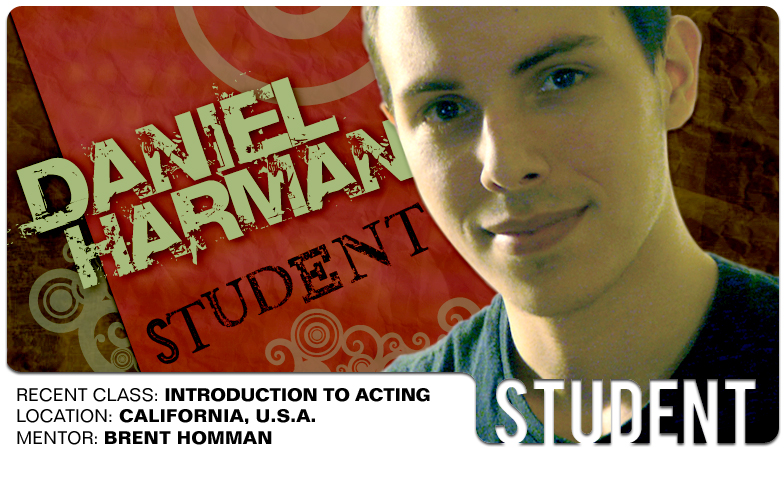
Daniel Harman Talks About His Experience as a Student at Animation Mentor
Animation Mentor:
When did you first become interested in character animation?
Daniel Harman:
Rather late, actually. I was not originally looking to animate when I was younger. I always knew I wanted to work in the entertainment industry, but I was not sure what role would best suit me. As I grew older, I picked up drawing, painting, and sculpting, and I started really honing my artistic skills at an arts high school. That is when I decided to marry the idea of working in entertainment with art. After graduating, I looked into what options were out there and what they would involve. I looked at some of the majors at the art school I wanted attend, and animation caught my eye. I never really understood how it was done and considered myself more of a classical artist than a “cartoony” one, so I never thought for a second that it was an option. The opportunity to be trained as an animator sounded intriguing. So I enrolled as an animation major and started collecting all the information I could on 2D and 3D animation starting that day. From that point forward, I never stopped soaking up information and learning everything I could get my hands on. Animation became my passion, and I am falling more and more in love with it every day.
Animation Mentor:
What contributed to your decision to go to an online animation school?
Daniel Harman:
It was not really a matter of deciding whether to attend an online school or a campus school; the decision was about where to go to get the best education. The first school I attended did not offer the quality and level of instruction that I had hoped for, so after nine months, I left and moved across the country to San Francisco and enrolled in the Academy of Art University. I had heard that it was the best school to go to for studying animation next to Cal Arts. I loved it there and in my first semester I did learn a great deal. When I was working on my final for my stop-motion class, I was talking with a couple of really talented 2D animation students. They both agreed that when it comes to learning 3D animation, the best place to go is Animation Mentor. I only knew of it from the advertising on the Animation Podcast, and thought that the quality of an online school could never compare to that of a university. I stayed up all night researching Animation Mentor, and the next day I called Admissions Advisor Victoria Tripp because I had to see if it was truly a better fit. The question was, “Do I want to be a character animator or a generalist?” I wanted to animate characters, and after talking to numerous people and conducting a ton of online research, I became confident that Animation Mentor was the best place to learn character animation.
Animation Mentor:
What is it like to go to an online animation school?
Daniel Harman:
I really enjoy being a part of an online school. The hours are very flexible; I can work in a comfortable environment; it is very easy to get feedback on work; no matter where I go, I can bring my school and community with me.
Animation Mentor:
What would be your ultimate dream job?
Daniel Harman:
It would be a job where I could lead a team of animators on a project and still get to animate. I would like it to be similar to how Richard Williams ran his studio – leading, educating, and animating. Hopefully one day I will find myself in that role.
Animation Mentor:
How has your experience at Animation Mentor been so far?
Daniel Harman:
I have enjoyed a great experience so far at Animation Mentor. From Maya Springboard to Advanced Body Mechanics, I have learned so much. In my short time at Animation Mentor, I have been very fortunate to have been instructed and mentored by Alexiss Memmott, Anthony Wong, Mark Behm, and Nicole Herr. They are all great teachers as well as great animators, who make their Q&As fun and engaging. The lectures are full of the information that is crucial to animators, and far better than any book you can find. Animation Mentor provides a fun and open environment that facilitates the sharing of ideas and opinions. The first thing I do when I wake up every day is check out my peers’ new work, which never ceases to inspire me. Working and communicating with such talented people is incredible. Everyone is friendly and more than willing to help when you have a question or need a critique. After seeing someone’s work, I often chat with them using Animation Mentor’s instant messenger to get to know them and to learn from them.
Animation Mentor:
What is the Animation Mentor community like?
Daniel Harman:
It is one of the best parts of the school, if not the best. It is amazing how having the school online opens it up to people from across the country and around the world. I have met so many amazing people from so many different countries, and many of these people will remain my friends long after I have graduated. It brings diversity to the work you see around the school. The other great part is how Animation Mentor brings together animators of all skill levels. In an ordinary school, everyone is at the same level as the rest of their class, whereas at Animation Mentor, the other students range from complete amateur to working professionals in the industry. This mix allows for an amazing educational experience among the entire peer community.
Animation Mentor:
What's the best piece of advice your mentor has given you?
Daniel Harman:
The best piece of advice I received from a mentor so far was during the Maya Springboard program, when Alexiss Memmott taught us to get out there and network with other animators and people in the industry. She told us that the more people who know you, and the more people you know, the easier it will be to uncover opportunities in the future. One point she emphasized was not just to meet a lot of people but to stay in touch, email every few months to see how they are doing, build relationships – not just to send our reels out to these people and beg for a job. If we play our cards right, when an opening does come along, those contacts will approach us. Ever since I heard Alexiss’s advice, I have been putting myself out there more. I realized that I could not afford to be shy or timid. I have been actively trying to meet with and learn from as many people as I can, and make connections that will last long after Animation Mentor. Thank you, Alexiss.
Animation Mentor:
Talk about a time when another student really helped you out.
Daniel Harman:
This is a tough one, because there really is not one time. My fellow students help me on almost a daily basis. I go to them with questions, for critiques, and for advice, and they take the time to work with me to figure everything out. Some students record video critiques to post on each other’s public reviews, or video tutorials to better explain some of the harder technical concepts of animation. I am always surprised and grateful when my classmates go out of their way to help me become a better animator. Animation Mentor’s community really cultivates the idea of helping others.
Animation Mentor:
Who is your favorite animator?
Daniel Harman:
Chuck Jones. I grew up watching his cartoons religiously every Saturday morning. His work on How the Grinch Stole Christmas and Rikki Tikki Tavi still stand out in my mind as some of my favorite animation, and nothing illustrates the power of character animation better than his short film, The Dot and the Line. Using fast movements and strong holds, I hope to incorporate some of his style into my own.
Animation Mentor:
What is your favorite animated/CG scene of all time?
Daniel Harman:
My favorite CG animated scene would have to be the first 10-15 minutes of WALL-E. You come into this dead, vacant wasteland seeing nothing but the remains of what once was. You hear soft music in the distance, and then you see him. Since I am a big science fiction fan, Pixar + the end of the world + robots = awesome. The childlike quality with which WALL-E approaches everything that humans have discarded is incredibly endearing. Whether he is deciding what to discard or keep, caring for his pet roach, or trying to figure out what something was for, it is extraordinary how the animators at Pixar were able to bring so much life and character to WALL-E, given his simple robotic anatomy and very limited speech. That little robot seemed more lifelike than most CG characters.
Animation Mentor:
What advice would you provide to a new Animation Mentor student?
Daniel Harman:
- Work on your shots early, and try to develop them a little every day, not just on Saturday.
- Post public reviews as often as you can. Some weeks, I post one every day.
- Critique at least one person per day. It will help them and help you hone your eye.
- Keep your shots simple. You will want to challenge yourself, but you do not realize how challenging even the simplest animation can be.
- Do not go crazy modeling. The point is to animate the character. Consider just having simple shapes represent the set/objects.
- Remember to save often. Ctrl+S is going to save you more than you know. Maya is not the most stable program, and saving often will keep you from having to redo work.
- Stay under the frame limit when possible. It is easier to spline and polish a 100 frame animation than a 200 frame animation.
- Talk to your classmates. Instant message your classmates with questions or just to chat.
- There are better ways to communicate with your fellow students than just instant messaging. Skype, Tiny chat and TokBox.com are all great places to go to work with your classmates and get to know them better. I am a big fan of TokBox.com, because it gives you the opportunity to video conference with up to 20 of your classmates at once. I have used it for critiques, study groups, and just to hang out at times. It you combine it with a program called ManyCam you will be able to share your desktop in real time and get instant input on your work. Make Animation Mentor better by using tools like this, it will help.
- Watch tons of reference. Make sure to use it at every stage of your animation.
- I am a big fan of video reference. I created a Vimeo group called AniRef where everyone can post and share video reference with each other. Check it out at: http://vimeo.com/groups/aniref.