
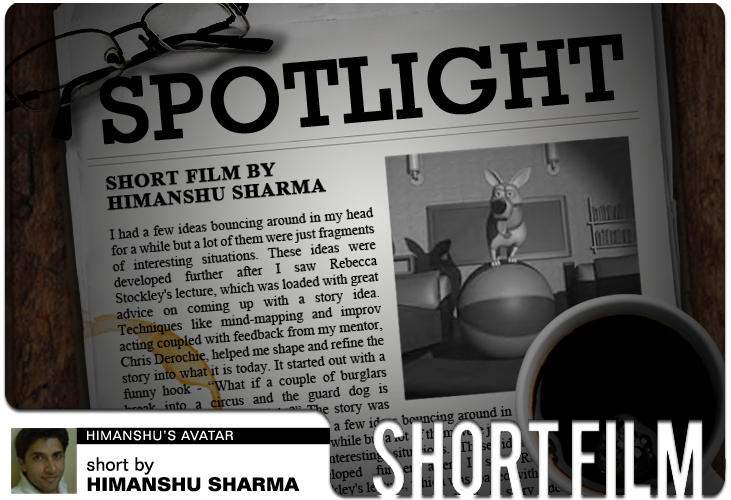
Spotlight: A Short Film by Animation Mentor Alumnus Himanshu Sharma
Animation Mentor:
How did you come up with the concept for your short film?
Himanshu Sharma:
I had a few ideas bouncing around in my head for a while, but a lot of them were just fragments of interesting situations. These ideas were developed further after I saw Rebecca Stockley's lecture, which was loaded with great advice on coming up with a story idea. Techniques like mind-mapping and improv acting coupled with feedback from my mentor, Chris Derochie, helped me shape and refine the story into what it is today. It started out with a funny hook: “What if a couple of burglars break into a circus and the guard dog is entranced by their flashlight?” The story was pretty elaborate in scope when I first visualized it, but my mentor helped me pare it down to something that could be finished in a reasonable amount of time.
Animation Mentor:
What important lessons did you learn from making your short film?
Himanshu Sharma:
Pick your battles wisely: You can't do everything because of shortage of time or skills. There will be areas that you have to compromise so that you can get other parts right. I don't know how to rig or model so I ended up using a lot of free models and props that I found on web sites.
Be open to change: A good example of this would be the very first shot of the film. I had the burglar pop up from behind the wall and my mentor thought the audience could easily mistake him for the owner of the house. We had to establish that this guy was indeed a burglar, so I changed his introduction in that shot by having him pop up from behind the bushes. I believe it made the shot much stronger.
Animation Mentor:
What was the best piece of advice you received from your mentor or your peers?
Himanshu Sharma:
Trust the process! There were big moments of second guessing on my part, but feedback from my mentor helped me get through that tough time. When you work on something for a long time, you tend to lose the initial enthusiasm because you have been through the story a million times. The gags don't seem funny anymore and as you work through the story, it seems to lose its entertainment value to you. Making a film is akin to piecing together small parts to build a cohesive whole and sometimes those individual parts might not make much sense. So you have to stick with what you believe in and watch it all come together in the end.
Animation Mentor:
What were the steps in your planning process?
Himanshu Sharma:
The story started out with a written outline of the short film, which was strengthened by feedback from my mentor and peers. Then came the story pitch which required us to act out the main story beats in a short video. Once the story was fleshed out, we moved onto the storyboarding process. I explored camera angles, character poses and basic staging by drawing rough thumbnails. The storyboard drawings were then used to make an animatic with temporary background score and sound effects. This was a really exciting step because we could see the storyboard drawings cut together for the first time, which gave me a good idea of the overall tempo and editing of the shots.
Once the animatic was locked down, I jumped into Maya to do layouts.
Animation Mentor:
Do you mind sharing some of the pre-production work with us with a little explanation of what we're looking at?
Himanshu Sharma:
Pitch – The pitch is self explanatory. I had to act out to show the poses and expressions of the characters to give an overall idea of what the story was going to be. I wasn't 100 percent comfortable about the story pitching assignment because I had never pitched a story to anybody before, but in the end it turned out fine and I think it gave me the confidence to pitch a story to anyone!
Animatic – The storyboard drawing strung together to a temporary background score and sound effects. It was a bit of a challenge to determine the length of each shot and how it related to the overall rhythm of the story.
Layout – The transition from animatic to 3D. It was fun to set up the 3D camera – a process that I really enjoy!
Blocking – First pass of blocking with main poses and breakdowns.
First Pass – This is when I started paying attention to arcs, weight, eases, facial expressions. I offset keys to loosen up the limbs and spine.
Polish – This part was a breeze because I tried to refine the motion as much as I could during the first pass. Polish pass was all about adding an extra layer of finesse and making sure there were no glitches in the spacing and arcs.
Animation Mentor:
What obstacles, if any, did you experience during the creation of your short film? How did you work your way around them?
Himanshu Sharma:
I didn't face many obstacles related to animation as my pre-production mentor made sure that at the end of the semester we had a 100 percent working animatic. This enabled us to concentrate completely on the animation in the final semester. However, this was the first time I was animating a quadruped character and it wasn't easy. I had to study a lot of video reference of circus animals performing. My mentor, Greg Whittaker, was spot-on with the critiques which helped me a great deal with breaking down and understanding the dog's motion.
Animation Mentor:
How did Animation Mentor help you create your short film?
Himanshu Sharma:
Animation Mentor helped me with every step of the process. The way the program is set up encourages you to experiment and explore because you know you have the safety net of your mentors and peers.
The pre-production semester was a compact crash course in film making. It covered various aspects of film making – story structure, storyboarding, sound, editing, cinematography and even Maya file management, which informed the choices I made for this film. The weekly assignments are designed to make you stick to the timeline of the production process in a professional studio. But more than anything, it was the mentors and my peers who helped me develop and finish the film.
I remember how Chris Derochie went the extra mile by showing our animatics to his children, just to get some unbiased and honest reactions to our stories!
For the final semester, I had a really supportive mentor, Greg Whittaker. He was always ready to listen and came up with some valuable mid-week feedback that helped me finish the animation on time.
Oh yeah! A big dose of BOOM from Bobby Beck in the video news was always a good way to start the week.
Animation Mentor:
What advice do you have for other students who haven't started their short film yet?
Himanshu Sharma:
Carry a sketchbook! Observe life around you. Sketch and scribble down anything that seems interesting. Keep these sketches and notes handy so that when it comes time to develop a story idea, you can draw on something you experienced firsthand as opposed to looking at movies for inspiration.